


20-Second Summary
When it comes to research writing, whether it is your bachelor’s research or a Phd dissertation, you really need to do a lot of research and writing, requiring you to not only write your own literature review based on previous searches done in your domain, but also to add your own research and properly interpret the results and add professional citations.
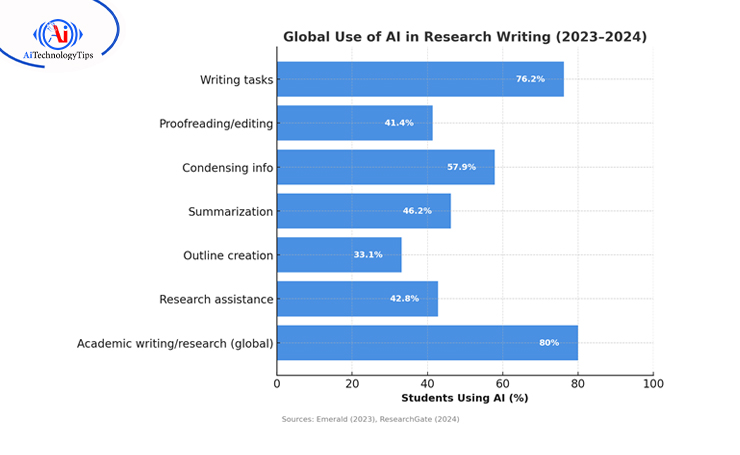
Almost 76% students now use AI in their research writing, with almost 41% using it for proofreading their final drafts.
In the past, things were really cumbersome, from going to libraries to study for research, to using the internet for finding research papers to read and review at the ease of home, we now have AI embedded in research writing tools, enabling students to use AI tools to speed up research writing.
This blog will help you explore the best AI tools for research writing, which you may use to help you write your thesis and research paper.
How AI Tools are Making Research Writing Easy
When we look at the trends of AI being used by students globally in research writing, we find that AI is making research easier for students globally. Before we move on to state some advantages of AI Tools for research writing, let us have a look at the stats of AI tool usage across the globe from 2023 to 2024, based on the information from Emerald Insight and Research Gate.

According to surveys published by Emerald Insight and ResearchGate in 2023 and 2024, 76% of students have reported using AI for their research writing, while 41% students used AI for proofreading their final drafts.
Advantages of AI Tools for Research Writing
- With the help of AI tools in research writing, researchers can reduce the time spent researching articles manually and get assistance from AI to find the research papers that match their research intent. This helps them to focus more on critical thinking, data analysis, and their intellectual efforts.
- With extra time on hand and an AI assistant, students can actually improve the quality of their research by ensuring consistency, language, accuracy, and relevance with other searches, keeping a focus on how the present study adds value to that and brings something new.

- AI research tools enhance the productivity of the author by helping them to process and complete the search at a faster rate.
- AI tools also help the researchers maintain their educational integrity by providing them with plagiarism checking, along with guidance on how they can ethically reduce it themselves.
- Another important benefit of using AI tools in research writing is how they can help you understand complex data analysis in simple language. All you need to do is share the image of complex models to understand them in an easy language.
- AI research writing tools also help to paraphrase and proofread for grammatical errors, ensuring your final draft is right and crisp in grammar, reducing the chances of rejection or further amendments requirements from the supervisors.
Ethical Considerations before Using AI for Research Writing
There are some ethical considerations you must know before moving on to using these tools for your research writing.

- Make sure that you are reading through the research papers completely and not just relying on the summaries given by the AI to draft your literature review.
- AI can only generate topics based on its search on previous studies, but your topic must entail your contribution as well, and be purely yours.
- AI can tell you research gaps, but you must ensure to read the research to determine if there is something more or less to that information.
- Do not trust AI with citations; they can be wrong sometimes, so make sure you double-check citations.
- Regularly evaluate and update your Literature review and ensure you cross-check after AI suggests to you more recent research.
- While prephasing, do not rely on AI paraphrasers, because they may paraphrase but alter the meaning. Read the text and make changes where needed to make sure the research stays intact.
10 Best AI Tools For Research Writing
Now that we know the role that AI tools play in research writing and how to use them ethically, let’s explore the ten best AI tools for research writing.

ChatGPT
ChatGPT is an AI chatbot that has been developed by OpenAI. It uses NLP and can converse like a human to its users and help them with their questions.
ChatGPT, when used as an AI tool for research writing, can help its users to find and summarize the research related to their topic, write articles, suggest changes, and even translate languages for non-English students.

Features
- Its features include Drafting, rewriting, summarization, Q&A, and brainstorming.
- The tool is flexible, conversational, and supports plugins.
- It can be ideal for general research, idea generation, and literature review exploration, as it can help you find the research papers in your field and topic.
- The tool also provides integrations with third-party web apps and API.
Pros and Cons
The pros and cons of ChatGPT as an AI tool for research writing are given below.
Pros of ChatGPT as a Research Writing Tool
- Helps with brainstorming ideas and outlines for research
- Helps non-native speakers by offering translations
- Helps to simplify complex topics and models for better understanding
- Versatility in tasks like drafting, summarizing, etc
Cons of ChatGPT as a Research Writing Tool
- Risk of misinformation and hallucinations
- May suggest citations from poor resources
- The database is generic, not scientific research-oriented
- Needs good prompting, can be inconsistent in providing details
Pricing
Although ChatGPT provides three plans, including their free plan, Plus plan at the price of $20, and Pro plan at $200. But we recommend research writers to opt for the Pro plan because researchers need to analyze complex data and generate high-quality content, for which ChatGPT Pro offers a comprehensive set of tools, including the Deep search feature.
While the $200/month cost is a significant investment, the enhanced features and capabilities it provides can substantially improve the quality of your research endeavors.
Grammarly
Grammarly is an AI-powered tool that is the holy grail for research writers. It not only offers basic grammar and spelling check but also helps one to improve their research writing’s impact by making it clearer, concise, and sets the tone as per the intent of the researcher,s along with AI capabilities like rephrasing and checking for plagiarism.

Features
- It provides Grammar, spelling, tone, plagiarism check, and clarity.
- Grammarly is of great help for non-native English speakers and provides excellent proofreading.
- The AI tool can be integrated with MS Word, Google Docs, browser, and email apps, making it easier for the research writers to keep a check on their grammar and mistakes while writing.
- It is a great tool for rephrasing and proofreading, grammar check, and style polishing.
Pros and Cons
The pros and cons of Grammarly are given below.
Pros of Grammarly as a Research Writing Tool
- Provides instant grammar and punctuation checks
- Checks for plagiarism against published work available online
- Enhanced readability of the document by providing sentence structuring suggestions
- Supports multiple languages and gives suggestions to help improve
Cons of Grammarly as a Research Writing Tool
- May flag complex research terminology as wrong or alter its meaning based on its correction requirements
- Premium features like Plagiarism detection may require a paid subscription
- Can struggle with a nuanced academic context, leading to inappropriate suggestions
- Depending too much on Grammarly may develop a bad habit of not rechecking the research write-up manually
Pricing
Grammarly is available as a free and premium service, with the premium version providing more advanced features like plagiarism detection and personalized style guides.
We suggest that researchers invest in the Pro plan, which costs approximately $12/month, billed annually, or $30 if billed monthly, and offers:
- Rewriting the complete sentences with one click
- Adjusting your writing tone with your writing style
- Write fluently in English.
- Unlimited personalized suggestions
- Detecting plagiarism and AI-generated text
- Generating text with 2,000 AI prompts
Paperpal
Paperpal is another tool built for research writers, which has been trained on 22million+ research papers. The tool has been tailored for academic and research writing, which not only helps with manuscript preparation but also helps with citations, grammar checks, plagiarism checks, and proofreading.

Features
The features of the tool include paraphrasing, chatPDF, proofreading, Citations generation, Grammar check, plagiarism check, AI writing assistant, AI Essay writer, Manuscript checker, AI translator, AI proofreader, AI reference founder, and AI summarizer.
Pros and Cons
Let’s have a look at some pros and cons of the tool.
Pros of Paperpal as a Research Writing Tool
- Provides strong research writing support
- Offers real-time suggestions and edits
- Helps to cut down the time on revisions
- Helps to detect plagiarism for better editing
Cons of Paperpal as a Research Writing Tool
- Free plan offers limited features
- Subscription cost may be a barrier for a few
- Sometimes makes incorrect changes, hence manual checkups are recommended
- Does not help with content generation
Pricing
The tool offers annual ($11.5/month), quarterly ($18.3/month), and monthly ($25/month)plans for its users. The plans are mostly on discounts for different countries; therefore, we recommend checking the website for final and updated pricing quotes.
QuillBot
QuillBot is an online AI-powered writing assistant tool that helps research writers to paraphrase their text, perform a plagiarism and AI check, do a grammar check for any errors in the text, and also helps to summarize long texts with assistance for generating citations as well.

The tool also offers an AI humanizer while rephrasing and can be integrated via its web browser extensions for efficient use in writing.
Features
The features of the tool include Paraphraser, Grammar check, AI detector, plagiarism checker, AI chat, AI humanizer, Translator, AI summarizer, and cite generator.
Pros and Cons
The pros and cons of Quillbot are as follows:
Pros of QuillBot as a Research Writing Tool
- Good with paraphrasing and summarization
- Built-in citation generator
- Offers browser integrations and is easy to use
- Premium features offer plagiarism check, making it an ideal all-in-one tool for writing, proofreading, AI, and plagiarism check
Cons of QuillBot as a Research Writing Tool
- The paraphrased text sometimes appears too robotic
- Paraphrasing sometimes changes the meaning of the text; hence, a manual check is recommended with each paraphrasing
- Premium cost can be a barrier for someone on a tight budget
- Depending on the tool, it can not only impact one’s writing skills, but one may ignore the misleading paraphrasing, causing harm than good
Pricing
QuillBot Premium offers competitive, flexible pricing.
- The annual plan costs $8.33 monthly.
- The semi-annual plan costs $13.31 per month and is billed every 3 months at the cost of $39.95.
- The monthly plan costs $19.95.
The perk of using QuillBot is that it:
- Offer a 100% money-back guarantee, allowing you to request a full refund if you are not satisfied
- You can also pause your premium subscription and use it only when you need it
Jasper AI
Jasper AI is also among the AI writing tools for research papers. It can help researchers to brainstorm ideas, create outlines for their research paper, and produce content text based on the prompts by the researcher, helping them to speed up their workflow and produce content that is relatable to their research.

Features
- The tool helps with AI content generation, a document editor, a plagiarism checker, Jasper chat to talk and generate ideas, and a Chrome extension for easy integration while researching.
- Although it can provide long-form content, it requires close human check to keep the content in check, especially for complex topics.
Pros and Cons
Pros of Jasper as an AI Tool for Research Writing
- It produces fast results, saving the user time
- Provides a plagiarism check
- If you provide clear and on-point instructions, Jasper gives out high-quality outputs.
- It offers a grammar check by underlining mistakes and sometimes offers corrections with a click
- The interface of the tool is very easy to use
Cons of Jasper as an AI Tool for Research Writing
- The tool might not be able to generate quality content for more technical or complex topics.
- When using Jasper, you must do a manual check on facts like dates and numbers when needed. Do not rely on the tool solely.
- The tool may cost extra money for a plagiarism check.
Pricing
The tool offers a free 7-day trial. For the paid plan, it costs $59 per seat per month, along with a business plan, which gets a custom quota, but we recommend you use the free trial to see if it works for your research topic. If your research is more on the technical side, you may explore other tools.
Elicit
The primary function of Elicit is to act as an AI research assistant for literature review.

Features
AI-powered literature search across 125+ million papers, automatic data extraction from papers, citation analysis, summaries, and bulk paper analysis
Pros and Cons
Below are some pros and cons of the Elicit tool.
Pros of Elicit as an AI Tool for Research Writing
- Powerful AI for research synthesis
- Excellent for empirical research
- Good data extraction capabilities
- Free tier with substantial features
- Continuously improving AI models
Cons of Elicit as an AI Tool for Research Writing
- Works best for empirical domains only
- 90% accuracy rate (requires verification)
- Less effective for theoretical research
Pricing
- Free (Basic): Unlimited search, limited extractions
- Plus: $10/month with deeper research features
- Pro: $42/month with Advanced workflows
- Team Plans is $65/month with collaboration
- Enterprise Plans: Custom Quotations
Authorea
Authorea is used for Collaborative academic writing & publishing.

Features
Real-time collaborative writing, LaTex support, Automatic citation formatting, Direct journal submission capabilities, and Multi-format import
Pros and Cons
Below are some pros and cons of the Authorea AI tool.
Pros of Authorea as an AI Tool for Research Writing
- Free for individual researchers
- Excellent collaboration features
- Professional publishing pipeline
- Provides multiple document outputs
- Owned by Wiley
Cons of Authorea as an AI Tool for Research Writing
- Limited AI assistance
- Primary focus on writing
- Learning curve for non-technical users
- Most of the advanced features are paid
Pricing
- Individual Use: Completely Free
- Collections/Institutional: $1,200/year
- Team Features: Paid plans available
Semantic Scholar
Semantic Scholar is an AI-powered literature search & discovery tool.

Features
Citation analysis and impact metrics, AI-powered semantic search, PDF reader, and paper recommendations.
Pros and Cons
Below are some pros and cons of the Semantic Scholar AI tool.
Pros of Semantic Scholar as an AI Tool for Research Writing
- Completely free
- Massive database coverage
- Advanced AI understanding of paper semantics
- Strong citation analysis tools
Cons of Semantic Scholar as an AI Tool for Research Writing
- No content generation or collaboration features
- No integration with writing tools
- Limited paper annotation capabilities
Pricing
The tool is completely free.
Scholarcy
Scholarcy is an ideal AI research writing tool for Research paper summarization & analysis.

Features
Automatic paper summarization, Reference list generation, citation analysis, and flash cards generation from paper.
Pros and Cons
Below are some pros and cons of the Scholarcy AI tool.
Pros of Scholarcy as an AI Tool for Research Writing
- Saves time on literature review
- Content summarization
- Helps to understand complex papers
Cons of Scholarcy as an AI Tool for Research Writing
- Subscription required
- Not suitable for all research domains
- Excellent Summarization
Pricing
- Free Tier: Limited summaries per month
- Premium: $9.99/month (pricing varies by region)
Consensus
An ideal tool for evidence-based research search with consensus analysis.

Features
Paper summaries and key findings, study methodology filtering, consensus meter for research claims, and citations count and impact analysis.
Pros and Cons
Below are some pros and cons of the Consensus AI tool.
Pros of Consensus as an AI Tool for Research Writing
- Quick answers
- Easy to use
- Excellent for systematic reviews
- Clear research consensus
Cons of Consensus as an AI Tool for Research Writing
- Smaller database compared to other tools
- Best for empirical research
- Good searching capabilities
Pricing
- Free: Basic search and limited features
- Pro Plan: $15/month or $120/year (billed annually, equivalent to $10/month)
- Team Plans are Available for institutions
Future Trends for AI Research Writing Tools
With the inclusion of AI in the education and research writing field, and the increasing use, institutes and teachers are wary of the fact that students might not be using their own research and analytical skills to the fullest while using these tools, hence a lot more restrictions and ethical consideration,s along with some performacne modifications are expected in AI tools in coming years.

Some key trends that we can expect have been listed below:
- We might expect to see tailored AI tools for different disciplines of research. For example, an AI tool for the humanities, business management, and economics.
- Tolls will be able to interpret charts, figures, and data, not just text, and these interpretations could be in the form of voice or video explanations.
- AI-powered peer review will enable the tools to detect errors, plagiarism, and fraud before submission of the documents.
- AI tools for research writing will be able to write or rephrase your content in your own writing style and tone.
- AI writing tools for non-native English writers will be available.
- AI tools for writing a thesis will be available at a low cost for students.
- Based on the ethical requirements, a mandatory disclosure of AI academic writing tools in academic publishing will be required, with tools that explain the edits.
- We might see AI collaboration and acceptance in publishing, with direct partnerships with the academic publishers for AI-powered authoring tools to generate submissions.
Final Remarks
Artificial Intelligence has set its foot in each industry, especially the research writing side of the education industry. Today, we have the best AI tools for research writing that enable researchers to complete their work at a fast speed, with assistance from creating an outline to generating citations and checking for plagiarism before submission.
But working with these tools, researchers and students must stay diligent and consider using their own analytical and research skills rather than depending on the tool slowly, which is ethically and intellectually the right thing to do.
For more such informative pieces on AI tools and trends, keep visiting AI Technology Tips.
Frequently Asked Questions
- What are the best AI tools for research writing?
The best AI tools for research writing include ChatGPT, Grammarly, Paperpal, QuillBot, Jasper AI, Authorea, Semantic Scholar, Scholarcy, Consensus, and Elicit.
- Can AI help in writing a literature review?
Yes, tools like Elicit and Semantic Scholar can help to summarize research papers and extract insights that can be used in a literature review.
- Which free AI tool is best for research papers?
Grammarly, Semantic Scholar, and Consensus offer free versions that aid in research writing, and ChatGPT can also be utilized as an aid for idea generation and guidance throughout the process.
- What are the risks of using AI in academic writing?
Risks involve losing the personal intellectual ability to research and the risk of using incorrect information provided by tools without verification.
- How can AI speed up thesis writing?
AI can help with drafting, paraphrasing, grammar, and plagiarism checks and suggestions to speed up the process.
- Which AI tool integrates with Google Docs?
Grammarly and Quillbot easily integrate with Google Docs to help with the research writing process.

