

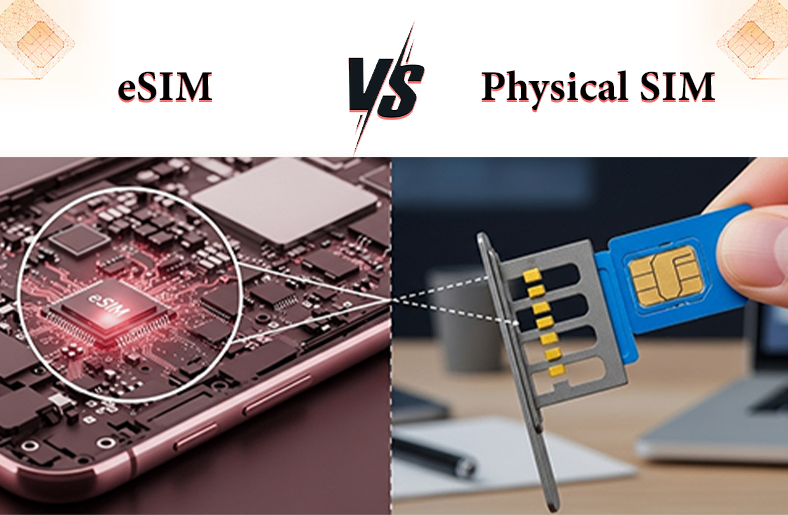
For many years, mobile phones used physical SIM cards for cellular service. Whether you needed your phone for work, fun, or a combination of both, these SIMs provided strong signals.
However, now the technology has changed. It introduced eSIM cards that are embedded directly into the phone and have carrier information through software.
As they become more popular, people are asking which is better, eSIM or traditional SIM. In this blog, we will dive into the detailed comparison of eSIM vs physical SIM and explore their setups, performance, security, pros, cons, and future trends of connectivity.
30-Second Summary
Like every other field, technology advancements can be seen in SIMs as well. With eSIMs, the entire landscape has shifted.
In this guide, we delve deep into comparing eSIM vs physical SIM. You will learn about their activation, setup, device support, performance, roaming, and environmental impact. Pros and cons of both SIM types will help you make an informed decision.
Setup and Activation: eSIM vs Physical SIM
Understanding how to activate eSIM vs insert SIM shows the main difference between them.

Physical SIM
Setting up the traditional SIM means inserting it into the SIM tray. The regular SIM is activated the moment you insert it into the slot.
eSIM
Whereas an eSIM (stands for embedded SIM) is a small programmable chip that is built directly into your mobile phone. It eliminates the need for a physical SIM slot.
To activate eSIM, users scan the QR code or follow the instructions of the carrier through the mobile app.
This process is called remote provisioning (eUICC remote provisioning) and lets you download the profile of the carrier digitally. You can instantly switch between profiles and plans, as an embedded SIM chip can store multiple profiles.
Device Compatibility and Support
Both physical SIM and eSIM serve the same purpose: connecting your device with a mobile network. However, the way they do it is different.

Physical SIM
Physical SIM cards are almost universal. The majority of the mobile phones manufactured in the last two decades support this chip, making it convenient for users with old or budget-friendly devices.
However, they need a dedicated SIM slot, physically inserted, and swapped when you want to change the network. As older phones depend on the traditional SIM, it limits users who want to switch carriers digitally.
eSIM
While eSIM compatibility with older phones is not great, newer devices from major brands(Google, Apple, and Samsung) support it.
Apple iPhones: Apple started iPhone eSIM support with iPhone XR and XS. They had a dual option for both a physical SIM card and an eSIM. However, in some regions, iPhone 14 and 15 are totally dependent on eSIM, removing the SIM slot entirely.
Samsung Galaxy devices: Many flagship Samsung device models, such as Galaxy S and Z series, allow customers to use both physical and eSIM simultaneously.
Google Pixel: The Google Pixel eSIM support started with the model Pixel 3. It made carrier switching faster and easier.
While you see physical SIM cards in developing regions and entry-level devices, the support from major flagships shows that eSIM will be the standard in the future.
Performance Comparison
When it comes to eSIM performance vs a SIM card, there is no major difference between their cellular connectivity and speed. Both use the same 4G, LTE, and 5G network bands provided by their mobile carriers.
In fact, eSIM performance is slightly better in situations that require you to switch networks quickly. You can easily jump from one carrier to another. It is particularly superb for people who travel a lot or professionals who need to switch networks often.
Regarding the eSIM vs physical SIM speed test, network quality matters for data speed and reliability, not SIM type. So, whether you use an eSIM or a regular SIM, the performance directly depends on the carrier’s infrastructure.
eSIM vs Physical SIM Security Risks
Both SIM types have different security threats.

Physical SIM
A traditional SIM has multiple security issues, such as it can be stolen, cloned, or swapped. Users are vulnerable to SIM swap fraud, where attackers get access to your personal phone number and online accounts.
eSIM
eSIMs are digitally embedded and encrypted, which is an advantage for users. Their IMSI and ICCID SIM profiles are secured in the device’s hardware and protected by carrier authentication. It makes unauthorized access much harder.
However, these are entirely risk-free. If a cyberattack on carrier systems or the remote positioning process happens, it threatens your safety, too. Still, many experts agree that eSIM is more secure than a regular SIM in many cases.
Travel and Roaming Convenience
Both eSIM vs physical SIM have their own drawbacks and benefits when it comes to traveling.

Physical SIM
A traveler with a physical SIM card has to buy a new one at every destination, swap it in the SIM tray, and manage multiple chips throughout the journey.
While traditional SIMs are widely used in many regions, this constant switching can become inconvenient and costly due to roaming charges.
eSIM
eSIMs have simplified this process entirely. Travelers can easily purchase and activate any regional or international eSIM plans online. You do not have to find a store or manage multiple physical cards.
This makes eSIMs ideal for frequent travelers and digital nomads. Moreover, it provides lower roaming costs as users can compare prices instantly and choose the best option for traveling.
Roaming Cost eSIM vs SIM
A dual SIM setup with both physical and eSIM is better. You can keep your number active for calls and use an eSIM for affordable local data.
Below is a difference between roaming costs and other aspects of an eSIM and a traditional SIM card.
| Aspect | Physical SIM | eSIM |
| Typical roaming cost | $50 to $100 for 5GB (home carrier roaming rates) | $8 to $20 for 5GB (global or regional eSIM plan) |
| Setup process | Buy a local SIM abroad and insert it manually | Purchase and activate through the app or QR code |
| Flexibility | One carrier at a time | Switch carriers or plans quickly |
| Coverage | Works everywhere (all phones support it) | Wide but not universal. Some regions or older phones lack support. |
| Convenience for travel | Requires SIM swap and local registration | No SIM swap needed, instant global access |
Enterprise and IoT Applications
When talking about eSIM in IoT vs physical SIM cards, eSIMs offer better flexibility.

Physical SIM
Physical SIM cards need manual installation, replacement, and shipping whenever a device switches carrier or location. It creates logistical challenges as well as higher maintenance costs for large-scale IoT deployments, such as industrial sensors and connected vehicles.
eSIM
eSIM has remote provisioning benefits. It allows IT teams to activate, update, and switch carriers instantly. You do not need a new SIM card every time you plan to switch. It saves your time, reduces downtime, and eliminates the need for physical handling.
eSIMs are ideal for enterprises as they are cost-efficient, scalable, and help them stay connected globally.
Environmental and Sustainability Impact
Have a look at which SIM type is better for our environment.

Physical SIM
In comparison of the plastic waste of SIM cards vs eSIMs, regular SIMs involve plastic manufacturing, packaging, printing, and global distribution. It leads to excessive carbon emissions and electronic waste.
eSIM
The positive eco impact of eSIM over physical SIM is greater. It exists digitally inside the device, eliminating the need for physical materials and shipping. This limits plastic waste and the bad environmental impact of production and transportation.
Pros and Cons of eSIM and Physical SIM
Have a look at the drawbacks and pros of eSIMs and regular SIMs.
eSIM: Pros
- There is no need for a SIM tray or a physical card.
- It allows quick carrier switching.
- It has lower roaming fees.
- It is programmable remotely through QR code or app.
Cons
- It is not supported on every device
- It needs the internet for activation.
- It has limited usage in some regions.
- The troubleshooting needs technical knowledge.
Regular SIM: Pros
- It is supported universally by all phones and carriers.
- It works offline without the need for any apps.
- It can be used in almost all areas.
- It is easy to remove and transfer.
Cons
- It can be lost and damaged easily.
- It is not ideal for international travel.
- It is a source of plastic waste.
- It is an easy target for a SIM swap scam.
The Future of SIM Technology
This shift from physical SIMs to eSIMs is a major development. Many of the latest Android devices and Apple models are already using eSIMs.
Users will be able to switch smoothly between carriers with eUICC technology advancements. They will manage multiple numbers and connect with more devices without the need for physical chips.

With more IoT and 5G expansions, the focus of SIM technology will be convenience, sustainability, and a hyper-connected ecosystem.
Wrapping It Up
In the whole eSIM vs physical SIM debate, eSIMs have some clear advantages. Whether it is digital activation, security, or environmental impact, these SIMs have a clear edge.
Physical SIMs are still active, especially in the old mobile models and regions with limited carrier support, but the shift is obvious. The future of SIM connectivity is clear. It will be smarter, greener, and flexible than ever.
Ready to learn more about new technology? Feel free to visit AI Technology Tips.
FAQs
Is eSIM More Secure than a Regular SIM?
Yes, eSIM is generally more secure than a physical SIM card. It is embedded digitally into your device and cannot be stolen, cloned, or damaged. The risk of SIM swap fraud is also less as activation occurs through the carrier’s secure network.
Which Phones Support eSIM?
Many major brands, including Apple, Samsung Galaxy, and Google Pixel, support eSIMs.
Does eSIM Work Everywhere?
Not yet. While many people are using newer models with eSIMs, there are many regions and carriers that do not support them. Users need to check eSIM support when traveling to less developed areas.
Does eSIM offer Better Performance than a Physical SIM?
There is no difference when it comes to connectivity between eSIM and a physical SIM card. Both use the same 4G, LTE, and 5G network bands. However, eSIMs offer quick carrier switching and better network flexibility.

