

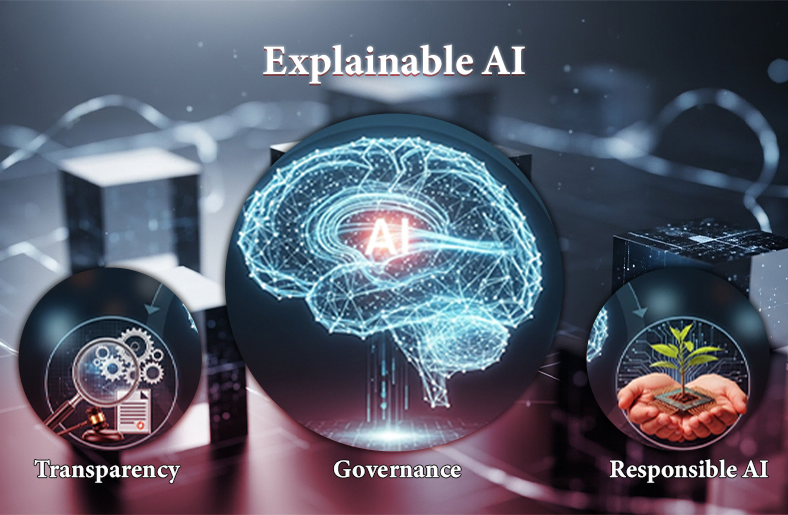
As artificial intelligence becomes a major part of our everyday life, the demand to make it transparent has also increased. AI uses a set of algorithms to provide answers to users’ queries. But have you ever wondered how it reaches a specific conclusion? This is where explainable AI, or XAI, comes in.
Let’s understand what explainable AI is, how it works, its key techniques, its benefits and real-world examples, and its role in responsible AI.
Key Takeaways

- Explainable AI builds transparency and helps humans understand how an AI model made a certain decision.
- Responsible AI ensures that AI systems remain fair, safe, accountable, and aligned with societal values.
- AI governance establishes policies, monitoring systems, and audits to ensure that AI is used responsibly.
- Together, they create reliable AI systems to ensure trustworthiness, reduce bias, and promote fairness.
What is Explainable AI (XAI)?
Explainable AI is a disciplined approach of methods and processes applied during the machine learning lifecycle to make AI outputs transparent and understandable to humans. It answers questions like

- Why did the model choose this and not that?
- When was the AI model successful, and when did it fail?
- How can I trust its output?
- How can I correct an error?
XAI should display its understanding by explaining how it took past actions, its ongoing process, and its future steps. It should also be able to cite relevant information on which it took any particular action. Basically, XAI encourages AI to show and explain its work.
Key Benefits of Explainable AI
As explainable AI helps users understand how AI models come to particular conclusions, it leads to the following advantages.
Increased Trust

Trust between humans and AI algorithms is important when it comes to successfully implementing different technologies. XAI aims to help users trust their AI applications by showing how they produce results.
Reduced Risk
Through explainable AI, you can assess different AI models and understand which one suits your needs the best, reducing the risk of trusting the wrong application.
Better Collaboration
Explainable AI supports cross-functional team dynamics. For instance, in the banking environment, an AI model is rolled out, and it rejects a loan application. The XAI highlights the main factors behind the model’s decision, including a low credit score, a high debt-to-income ratio, and an inconsistent payment history.
This transparency improves collaboration between data scientists, risk analysts, and loan officers, ensuring decisions remain fair and aligned with financial regulations.
Faster Troubleshooting

When data scientists understand how a model is producing outputs, it becomes easier to develop and debug. While explainability techniques increase computational overhead, they significantly reduce the time humans spend on interpreting and verifying model decisions.
Less Model Drift
Model performance can degrade over time as new data shows up. However, XAI analyzes models and alerts you when they drift, and their outputs become inconsistent.
Enhanced Regulatory Compliance
XAI also helps companies align with regulations and privacy laws. The TFAIA (California Transparency in Frontier Artificial Intelligence Act) requires developers to provide transparency reports on their models’ risks and measures to mitigate them. Explainable AI helps organizations identify those risks easily.
The Problem with Black Box AI Models
A black box AI model is one that is so complex to understand or does not show its work, where no one, even the data scientists and engineers who created the algorithm, can explain how it reached a particular output.

For instance, GPT4, a neural network powering ChatGPT, performs around 3 trillion mathematical calculations to generate one word. If a person wanted to check these calculations and do one per second, it would take them 95 years to replicate the calculations needed to generate one word. In such scenarios, you can confirm that the output model generated is accurate, but checking what goes on behind the scenes is practically impossible.
This lack of transparency and interpretability in black-box models can lead to dangerous consequences when used for high-stakes decision-making, particularly in high-risk industries such as healthcare, the military, law, finance, and aerospace.
The role of explainable AI (XAI) is to look inside these black boxes.
Risks of Black Box AI
AI systems are trained on data, and if it is inherently biased, the output will be biased as well. For instance, if a company has a record of hiring male candidates a lot in the past 20 years, the model will learn to penalize resumes with female names.

Moreover, tracing a black box’s logic behind the mistake it makes is nearly impossible. It can cause serious legal complexity if someone is harmed; for instance, if a medical device or autonomous vehicle leads to a misdiagnosis or an accident.
When developers cannot understand the internal workings of an AI model, it becomes much harder to trace the problem and fix it. This is why trusting black box models is also difficult.
Role of XAI in Black Box Models
XAI acts as a translator, making black-box machine learning models transparent and interpretable to human users. It essentially bridges the gap between high-performing yet opaque AI and the need for trust, accountability, and regulatory compliance.
How Explainable AI Works
Explainability methods generally focus on model interpretability, which means how easily humans can understand the relationship between a model’s inputs and its predictions.
Here are the types of model interpretability.
Global Interpretability
Global interpretability focuses on understanding how the entire model works overall. It provides a complete view of how different features influence predictions of the model across the entire dataset.

For instance, in a model predicting house prices, global interpretability shows that location, property size, and number of bedrooms are the most influential variables affecting the output.
Global interpretability is particularly useful for
- Assessing whether a model aligns with real-world knowledge
- Ensuring that the model does not rely on biased or irrelevant information
- Auditing models for regulatory compliance
- Improving transparency in complex systems
Some models, like decision trees or linear regression, are easier to interpret. However, when it comes to complex models, specialized explainability is important to reveal their overall behavior.
Local Interpretability
Global interpretability explains overall model behavior, while local interpretability focuses on explaining individual predictions. It answers questions like “Why did the model make this specific decision?”
For example, a bank using an AI system for loan applications rejects a particular application. Local interpretability will show the main factors behind this decision, such as a low credit score or a limited payment history.
Techniques such as LIME and SHAPLEY are used to provide these explanations. They break down complex predictions and explain how each feature influenced the final outcome.
Local interpretability is ideal for
- Explaining decisions to users
- Investigating unusual predictions
- Supporting accountability in high-stakes applications like finance and healthcare
- Debugging and improving models
Feature Importance
Another key concept in explainable AI is feature importance. It identifies which input variables have the biggest influence on a model’s predictions.
In many machine learning models, there are different features that contribute to the final output. Feature importance techniques measure the relative impact of each variable and help users understand which factors matter most.
For instance, in a model predicting customer churn, feature importance analysis will show
- Frequency of product usage
- Recent customer complaints
- Length of subscription
Key Techniques Used in Explainable AI
The two techniques used in XAI are SHAP and LIME.
SHAP (Shapley Additive Explanations)
SHAP explains a prediction by showing how each feature contributed to the outcome that a model produced. It is based on game theory. For instance, when a team wins a game, SHAP tries to figure out how much each player contributed to the victory.

For example, an AI model predicts that a patient is at high risk of sepsis. SHAP might show something like
- A high heart rate increased the risk by 30%
- Low blood pressure increased the risk by 25%
- Low oxygen level increased the risk by 20%
All in all, it shows which factors contributed to the prediction and by how much.
- Ethical Implications: By using SHAP values, data scientists and developers can see whether sensitive information, such as age, gender, and race, is negatively influencing the outputs. Data scientists and developers can either adjust the model or the data it trains on to eliminate unfair or biased outputs.
LIME (Local Interpretable Model-Agnostic Explanations)
LIME explains one specific prediction by creating a simple temporary model around that. In other words, it does not try to understand the whole AI model and focuses only on the decision made for one case.

For example, the AI model classifies emails as spam or not spam. If this model marks a particular email as spam, LIME can analyze that specific prediction and highlight which words or features influenced the decision. It will show
- The presence of words like free or limited offer
- Multiple external links
- An unknown send address
This helps users understand why that specific email was marked as spam, even if the overall model is very complex.
What is Responsible AI?
Responsible AI is a set of principles that guide the development, design, and deployment of AI systems to build trust in AI solutions. Responsible AI considers the broader societal implications of AI systems and the measures that align these technologies with ethical and legal standards.
Responsible AI aims to integrate these ethical principles into AI applications to mitigate risks and maximize positive outcomes.
Core Principles of Responsible AI
Responsible AI is based on the following principles.

- Fairness
- Transparency
- Accountability
- Privacy and security
- Safety and reliability
AI Governance: Ensuring Responsible AI Systems
AI governance means establishing policies, procedures, and ethical guidelines, such as transparency, fairness, accountability, and privacy, that are necessary to develop and deploy AI systems responsibly.

Key Elements of AI Governance
The main components of AI governance include
- Model auditing
- Risk management
- Ethical guidelines
- Monitoring and evaluation
Why AI Governance Matters
AI governance is extremely important, particularly now when it has become a part of our everyday tasks. It is important to keep it in check to ensure regulatory compliance, prevent harmful AI outcomes, and build trustworthy AI systems.
Bias Detection and Fair AI Systems
The framework of responsible AI, AI governance, and XAI is important to detect bias in a model’s outputs.

Sources of AI Bias
The model can show bias and unfairness due to biased datasets included in its training, any historical inequalities, and poor model design.
How Responsible AI, AI Governance, and XAI Work Together
The combination of these three ensures that the AI models remain trustworthy from development to deployment and beyond.
- Responsible AI sets the ethical goals, such as fairness, accountability, and trustworthiness, that an AI model should achieve.
- Explainable AI (XAI) offers the technical transparency needed to meet the goals of responsible AI. It allows humans to understand, validate, and trust AI decisions.
- AI governance establishes the policies, rules, and oversight processes that enforce responsible AI practices and ensure explainability is applied properly across the organization.
All in all, responsible AI shows what should be achieved, XAI explains how these goals should be achieved, and AI governance ensures that all these standards are followed.
Real-World Applications of Explainable AI

Healthcare
XAI speeds up many healthcare processes, such as image analysis, medical diagnosis, and resource optimization. It allows you to see how the AI model’s decision-making process works for patient care. It also helps you streamline the pharmaceutical approval process.
Financial Services
It improves customer experience by providing them with a transparent credit approval and a transparent loan process. It also speeds up wealth management and financial crime risk assessments. It resolves potential complaints and builds confidence in pricing and investment.
Criminal Justice
Explainable AI optimizes processes for risk assessment and prediction. It accelerates DNA analysis, prison population analysis, and crime forecasting. It also detects potential biases in training data and algorithms.
Limitations of Explainable AI
Implementing explainable AI has become necessary; however, the system still isn’t perfect. Limitations of XAI include
- Technical complexity of output: Current XAI methods are extremely technical, which can only be understood by ML experts. This issue should be resolved by either more technical education and training or explaining complex issues in layman’s terms.
- High Computational Cost: Running explainable AI is expensive. The reason is that explanation algorithms have to perform extensive calculations to understand why a model produced a certain output. This might mean running the model thousands of times just to understand the logic behind a single prediction.
- Security Risks: Opening a black box model to understand its logic, but it can also reveal how the system works to outsiders. Malicious actors can use this information to trick the model, manipulate outcomes, or exploit its weaknesses.
The Future of Explainable AI

- Human-centric Design: Future XAI models will prioritize personalized results based on a user’s specific needs and expertise level rather than technical explanations.
- Hybrid Modeling: New research focuses on combining the high performance of deep learning with the interpretability of simple, logic-based models.
- Real-time Actionable Insights: XAI will provide real-time, actionable explanations, helping users understand the “why” behind a decision, particularly in fields such as healthcare and autonomous driving.
- Standardization and Regulation: With AI regulation, there is an initiative to develop standardized, quantitative metrics to measure the quality of explanations.
- Bias Detection and Mitigation: Explainable AI will be important for identifying and correcting ethical issues in AI decision-making processes, such as bias and unfairness.
Final Thoughts
As we use artificial intelligence more and more in our day-to-day activities, it is important that these systems are transparent, ethical, and accountable. This is where explainable AI, responsible AI principles, and governance frameworks work together.
They build a system that helps people trust AI, which is as important as building systems that perform well.
Visit AI Technology Tips to learn more practical AI insights.
FAQs
What is the Difference between Explainable AI and Interpretable AI?
The goal of both is to make AI models understandable; however, there is a difference. Interpretable AI refers to the models that are naturally easy to understand, such as decision trees or linear regressions. Explainable AI uses additional techniques, such as SHAP or LIME, to explain complex models that are not easy to interpret, such as deep neural networks.
Why is Explainable AI Important for High-Risk Industries?
In industries like healthcare, finance, and criminal justice, even a small wrong decision can significantly impact people’s lives. Explainable AI helps professionals understand why a model made a particular decision, detect bias, and ensure that the system they use complies with legal and ethical standards.
Can Explainable AI reduce Bias in Machine Learning Models?
Explainable AI does not automatically remove bias, but it helps identify where bias exists. It analyzes feature importance and model explanations and allows developers to detect any unfair patterns in training data and adjust models for fair decisions.

