

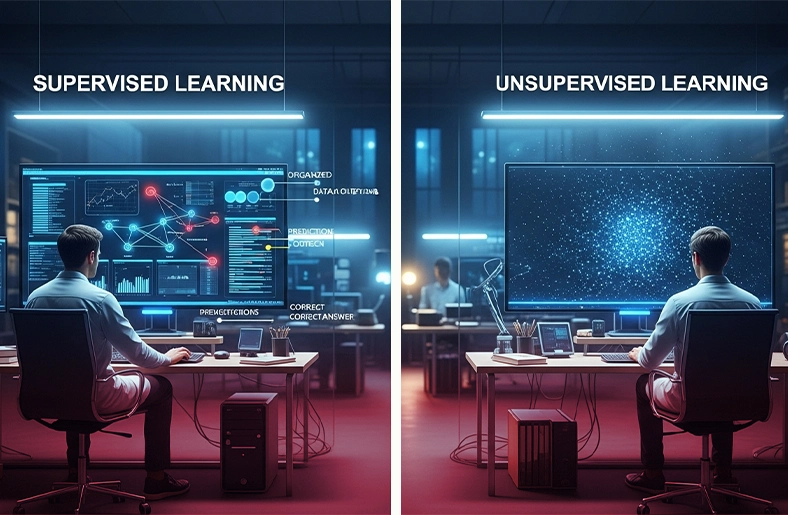
Every day, there is a new smart technology on the market. So to keep up, companies are increasingly using machine learning algorithms to make things easy for themselves. You see these algorithms in everyday items, like facial recognition on smartphones and alerts that help protect you from credit card fraud.
The two most common approaches in machine learning and artificial intelligence are supervised learning and unsupervised learning. They both contribute to smart technology. In this guide, we explore the supervised vs unsupervised learning differences in detail.
30-Second Summary
- Supervised learning uses labeled data for accurate prediction, while unsupervised learning finds patterns in unlabeled data.
- Supervised learning is excellent for medical diagnosis and fraud detection, while unsupervised learning is great for clustering, recommendations, and discovering hidden patterns.
- Choosing the right learning model depends on your goals, data type, and size. Semi-supervised learning is the best of both worlds.
What is Supervised Learning?
Supervised learning uses labeled data. Labeled data means that the input data already has a correct output attached to it. The model trains for accuracy by comparing its predictions with the correct output and adjusting based on errors.
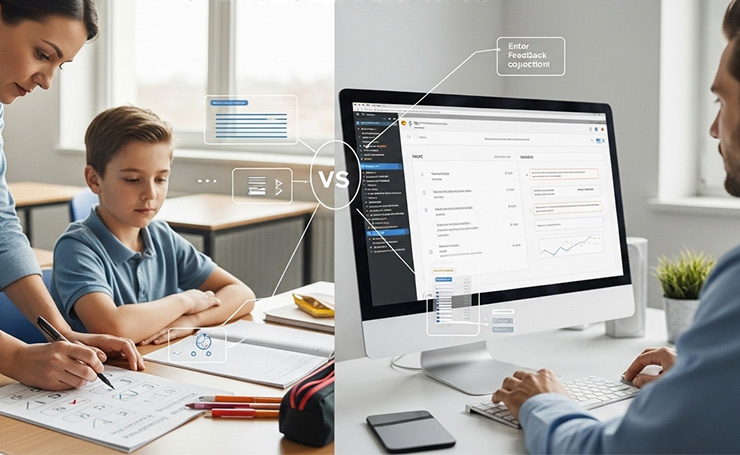
Let’s understand it with a very simple example. A teacher gives a student maths homework. The student writes the answer. The teacher then tells the student which answers are correct, and the students learn from their mistakes. Similarly, this model is trained using data that already has the right answers (labeled data).
Types of Supervised Learning
There are two types of supervised learning.
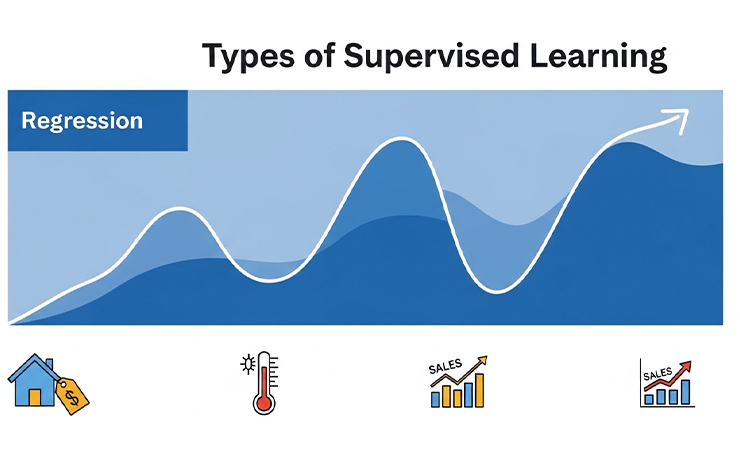
Regression
This type is used to predict continuous values, such as sales forecasting, temperature, and house prices. Regression models learn to map inputs to specific numbers.
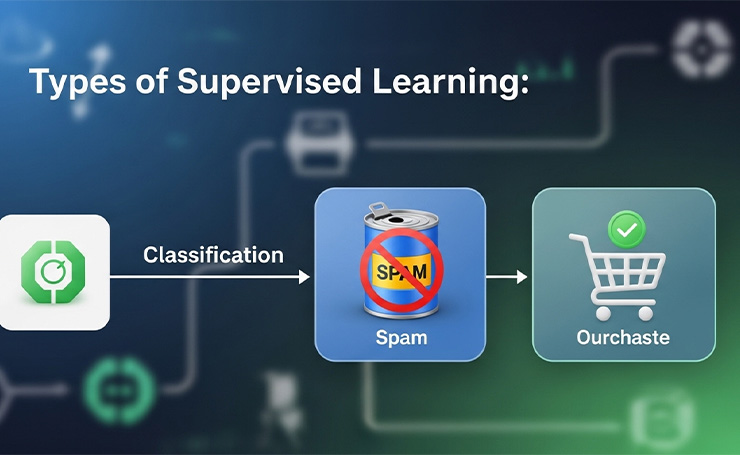
Classification
This type is used when the output is a category. For instance, it predicts whether an email is spam or not, or whether a client will purchase something or not.
Use Cases of Supervised Learning
Some real-world applications of supervised learning include
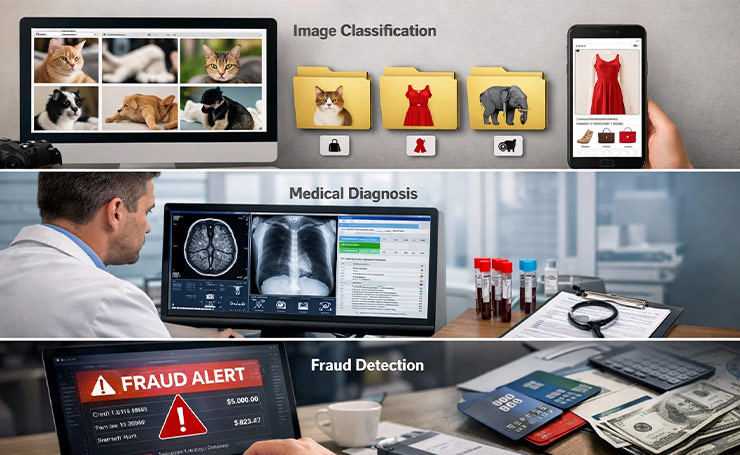
- Image Classification: It helps in image search and image-based product recommendation. It can also classify images into different groups like animals, clothes, and other objects.
- Medical Diagnosis: It is used to support accurate diagnosis by analyzing patient data, including test results, patient history, and medical images.
- Fraud Detection: This model analyzes transactions and looks for patterns to see fraudulent activities, making it important for financial institutions that want to prevent fraud.
Pros of Supervised Learning
- Supervised learning models make correct predictions on new data.
- These models improve as they are trained on more data.
- It can handle different computational challenges and works well for multiple tasks.
- Because it can predict numbers and sort data into categories, it is a flexible model for handling different problems.
Cons of Supervised Learning
- It needs labeled data for training, where every input is attached to a correct output. This requires money, effort, and time, and can even have mistakes, which makes supervised learning hard to use.
- It can struggle to handle abstract ideas or understand patterns that are not relevant to the data it is trained on.
- Supervised learning models may work perfectly for the data they were trained on, but might struggle with new, unseen data.
- This model requires continuous training to remain accurate as the real world changes.
What is Unsupervised Learning?
Unsupervised learning is the direct opposite of supervised learning. It is trained on data with no labels or categories. It analyzes this data without any prior knowledge and learns by finding patterns.

Let’s look at an easy example. You dump clothes on your bed and have no instructions. Yet you organize them into categories (like all shirts in one pile and all trousers in another) based on the similarities. Unsupervised learning finds patterns and relationships just like this for training.
Types of Unsupervised Learning
There are two types of unsupervised learning.
Clustering
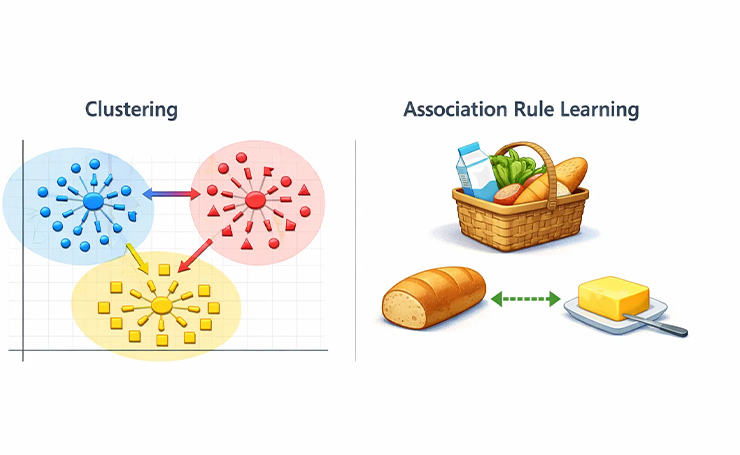
Clustering means grouping similar data points together. The algorithms continuously move data points toward the center and away from points in other groups to create clear clusters.
Association Rule Learning
This type finds associations and patterns between different items in a dataset. For instance, it looks for rules like people who buy bread also buy butter (creating an association between bread and butter).
Use Cases of Unsupervised Learning
Unsupervised learning can be used for the following.
- Customer Segmentation: It groups customers with similar characteristics to enable marketers target the right audience.
- Anomaly Detection: It identifies unusual patterns in data to detect security breaches or fraud.
- Recommendation Systems: It identifies similarities in user preferences and recommends products, movies, or music based on users’ tastes.
- Scientific Discoveries: It can analyze hidden patterns in scientific data and provide new insights and ideas.

Pros of Unsupervised Learning
- It does not need labeled data for training, so it is easy to work on large datasets quickly.
- It can reduce large data into simple forms without losing important patterns, making it manageable.
- It finds unknown patterns and relationships in data for valuable insights.
- It helps understand data deeply by showing meaningful trends and groups.
Cons of Unsupervised Learning
- Because this model has no labeled output, it is difficult to assess its accuracy.
- It can give less precise answers to complex problems due to the lack of clear guidance.
- After it groups the data, you might need to check and label the groups, which can be time-consuming.
- Missing data or outliers can impact the quality of the results.
Supervised Learning vs Unsupervised Learning
| Feature | Supervised Learning | Unsupervised Learning |
| Data Type | Labeled data | Unlabeled data |
| Goal | Predict outcomes | Discover patterns |
| Output | Known target variable | No predefined output |
| Evaluation | Easy to measure accuracy | Harder to evaluate |
| Common Tasks | Classification, Regression | Clustering, Association |
Which One is Best for You?
Choosing the right approach for yourself depends on your use cases and on how your data scientists handle the data’s structure and volume. Consider the following before selecting any learning model.
- Evaluate if your input data is labeled or unlabeled.
- Assess your goals: whether it is a recurring, well-defined problem or the algorithm needs to predict new ones.
- Look at your algorithm options. Make sure that the algorithm you choose can handle the number of features in your data.
If you have a large volume of data, supervised learning may not handle it effectively, but this model produces highly precise results. However, unsupervised learning is superb at handling a large volume of data, but a lack of transparency can lead to inaccurate results.
The solution is to go for semi-supervised learning.
What is Semi-Supervised Learning?
Can’t decide on which is the right fit for you? You can choose semi-supervised learning. It combines aspects from both supervised and unsupervised learning. Machine learning techniques that fall under semi-supervised learning use both labeled and unlabeled data.
This model is trained on small labeled data at the beginning, which is then used to predict labels on larger unlabeled datasets. Then the model is applied repeatedly to the original labeled data and the data it has predicted. This process is repeated to slowly improve the model’s performance.
Wrapping Up
Understanding supervised vs unsupervised learning is essential for everyone working in machine learning or AI. Supervised learning trains on labeled data and provides accurate answers. Unsupervised learning trains on unlabeled data and is perfect for clustering and discovering hidden details.
Whether you are a beginner or building real-world AI systems, knowing the types, applications, pros, and cons of both learning models helps you create efficient systems.
Feel free to visit AI Technology Tips to learn more about artificial intelligence and its branches.
FAQs
What is the Difference between Labeled and Unlabeled Data in Machine Learning?
Labeled data includes both input data and correct output, making it suitable for supervised learning. Unlabeled data only has input information without any predefined output, which is used in unsupervised learning to find hidden patterns.
Why is Supervised Learning more accurate than Unsupervised Learning?
Supervised learning has higher accuracy because it learns from correct answers during training. The model keeps adjusting based on errors. In contrast, unsupervised data does not have a target variable to optimize against.
Which is Better for Beginners: Supervised Learning or Unsupervised Learning?
Supervised training is generally better for beginners because it has clear outputs, measurable accuracy, and simpler evaluation methods. It provides a structured way for beginners to understand machine learning.
Is Deep Learning Supervised or Unsupervised Learning?
Deep learning can be both. Many deep learning models are supervised, like image classification, but some techniques, like autoencoders, fall under unsupervised learning.

