

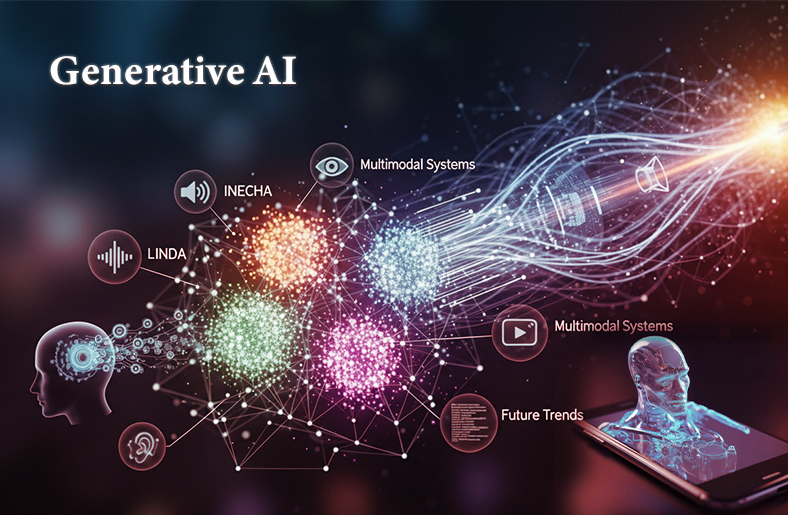
If you are interested in technology and its latest trends, you must have come across the term “generative AI.” Unlike traditional AI, which was limited to analyzing data and making predictions, gen AI can create entirely new content, including text, images, audio, video, and code.
In this guide, we will discuss how gen AI works, the major models behind it, the rise of multimodal systems, and the future trends shaping it.
30-Second Summary
- Generative AI produces text, videos, images, audio, code, and other media through simple language prompts.
- The models that power GenAI are GANs, VAEs, transformers, and diffusion for realistic content generation and automation.
- Multimodal Generative AI Systems are the next leap, as they can generate and understand text, audio, images, and videos simultaneously.
- The future growth of generative AI will focus on human-AI collaboration, hyper-personalization, and real-time interaction.
What is Generative AI?

Generative AI, or GenAI, is a specific subset of artificial intelligence that creates new content, like images, videos, sounds, code, text, 3D designs, and more, just with a prompt. The main driving factor behind GenAI’s success is that people can now put prompts using natural language. Therefore, it is used as an assistant or second brain in different industries like writing, designing, and coding.
How it Works
Generative AI models are trained using supervised and semi-supervised learning on large datasets, such as text, images, audio, and video.

They learn from patterns, relationships, and structures to predict the next most likely element (word, pixel, or sound). This AI subset produces new content based on probabilities.
Key Capabilities of Gen AI
- It can write articles and marketing copy.
- It can generate realistic images and artwork.
- It can compose music and voices.
- It can write and debug code.
- It can create synthetic data for research.
Traditional AI vs Generative AI
| Feature | Traditional AI | Generative AI |
| Purpose | Analyze and predict | Create new content |
| Output | Insights and forecasts | Text, images, audio, etc |
| Data | Structured datasets | Massive diverse datasets |
| Use Cases | Fraud detection and forecasting | Content creation and design |
Major Types of Generative AI Models
Take a look at four common types of generative AI models.

Generative Adversarial Networks (GANs)
A generative adversarial network has two opposite neural networks
- The generator
- The discriminator
The generator creates fake content that closely mirrors the data it is trained on, and the discriminator evaluates its authenticity. These two neural networks go back and forth until the generator wins or the discriminator cannot distinguish between fake content and the training data.
Variational Autoencoders (VAEs)
A variational autoencoder compresses data into a simplified representation that contains all the important elements and leaves the details. After encoding, the decoder reconstructs the original dataset and adds small variations, creating unique and new versions.
Transformer-Based Models
Transformer-based models help AI understand language as humans do. These models break text into small units, such as words, parts of words, or characters. Then they convert these tokens into numbers to determine their relationship. Transformers also have a self-attention mechanism that helps them understand the importance of some words over others in a sentence.
Diffusion Models
Diffusion models add noise (random sets of data points) to the input until it becomes unrecognizable. It then analyzes how the noise affected the data and removes it to reconstruct the original input. After training, the model uses the patterns it learned from its training materials to generate content that meets your prompt’s requirements.
Multimodal AI Systems

Multimodal AI is a subset of GenAI. It can generate several types of data, such as text, audio, video, and image, simultaneously. These systems combine several types of input and analyze and process data from multiple sources to generate new content.
A practical example of Multimodal AI is a self-driving car system that uses camera feeds, LiDAR data, and maps simultaneously.
How Multimodal Systems Work
Multimodal systems combine information from different sources through
- Cross-modal learning: It allows the model to focus on relevant parts of one modality while processing another. For instance, it matches the phrase “red app” to a specific pixel area in an image.
- Data fusion techniques: Early fusion merges raw data at the start, late fusion combines results after separate processing, and intermediate (hybrid) fusion combines features at multiple stages for a more balanced approach.
- Shared representation models: Multimodal AI maps different data types into one shared vector space, enabling the model to understand that they represent the same thing. For instance, it might map a photo of a dog, the sound of a bark, and the word “dog”.
Real-World Capabilities

Multimodal AI systems can
- Generate images from text prompts
- Analyze images and describe them
- Understand spoken commands
- Analyze video content
- Enable voice-based assistants
Leading Multimodal Systems
The leading multimodal systems include
- GPT-4V: It can understand and analyze images and text together, enabling tasks such as visual question answering, document interpretation, and real-world scene understanding.
- Gemini: It can process images, text, audio, and video content to provide contextual reasoning, real-time insights, and advanced assistance across digital tasks.
Applications of Generative AI
Generative AI has been used across multiple industries.

Content Creation and Marketing
Generative AI has become an assistant in content creation and marketing for many organizations. People use it for blog writing, copywriting, social media posts, video scripting, and ad creatives.
Healthcare
GenAI excels at healthcare. It is used to speed up drug discovery, streamline clinical research, and enhance patient care. Moreover, it can convert low-resolution medical images into clearer pictures. GenAI also provides plausible medical records on synthetic patient data.
Business and Customer Service
Businesses are increasingly using AI chatbots and virtual assistants to help with customer issues and streamline other tasks. Moreover, automated reporting provides companies with insights and forecasts that are important for their decisions.
Software Development
Software developers can use GenAI to optimize and auto-complete code faster. Moreover, developers can interact with software without using a programming language because AI would act as a translator.
Entertainment and Media
In entertainment and media, generative AI can create new visual content from scratch. It can add special effects and graphics, and even help edit videos and audio. Moreover, it can tag and index large media libraries and allows you to use conversational language to find the information or media you are looking for.
Benefits of Generative AI

- It increases productivity through automating several tasks.
- It streamlines workflows, consequently reducing costs.
- For artists and designers, it can help generate fresh, creative ideas.
- It offers rapid prototyping for ideas and products.
- It provides personalized experiences for users.
Challenges and Ethical Concerns

Despite its potential, GenAI poses serious concerns.
- These AI models can inherit bias from training data.
- AI-generated content can be used to spread malicious information like deep fakes.
- There are also issues regarding copyright and ownership of AI content.
- Training data can contain sensitive information, raising privacy concerns.
- Automation can change workforce demand, causing job displacement.
Future Trends in Generative AI
The following trends show where GenAI is heading and how it will change business operations and even everyday life.

Hyper-Personalized AI
Future AI will provide highly personalized experiences by learning user preferences, behavior, and context. GenAI will customize learning materials, product recommendations, marketing messages, and even health and fitness guidance. This level of personalization will lead to customer satisfaction, and the digital interaction will feel more human.
Real-Time Multimodal Interaction
GenAI is moving towards smooth interaction across images, text, video, and audio in real time. People will be able to communicate with AI through voice conversations, live translations, gesture-based commands in virtual settings, and real-time video understanding for assistance.
AI Agents and Autonomous Workflows
Generative AI is moving from a passive tool to active agents that can complete complex tasks independently. They can schedule, communicate, conduct research and summarize findings, automate customer support, and handle multi-step business operations smoothly.
Human and AI Collaboration
Generative AI is becoming a creative partner of humans, assisting them in multiple tasks. Professionals are increasingly using AI to come out of creative blocks, brainstorm ideas, speed up creative processes, and enhance decision-making.
Regulation and Responsible AI Development
Governments, institutions, and tech organizations are building frameworks for ethical AI development and deployment. These frameworks are focused on reducing bias, ensuring transparency in content, protecting user information, and preventing misuse, such as deepfakes.
Final Thoughts
Generative AI is one of the most revolutionary technologies of our time. It can produce new content, including text, audio, images, and videos. Moreover, it can also streamline several tasks, improving productivity and efficiency.
As multimodal systems become mature and AI becomes even more embedded in everyone’s life, the future will see human and AI collaboration. However, proper governance is needed to ensure ethical use of AI.
Explore more interesting AI-related information on AI Technology Tips.
FAQs
What is the Difference between Generative AI and Predictive AI in real-world Business Applications?
Generative AI creates new content like marketing copy, product descriptions, or designs, while predictive AI analyzes historical data to predict outcomes like sales trends or customer churn. Businesses mostly use predictive AI for decision-making and generative AI for automation and creativity.
How does Generative AI help Small Businesses?
Small businesses can use generative AI to write social media posts, create product images, start email campaigns, automate customer support, and draft proposals.
Can you use Generative AI for Personalized Learning and Education at Scale?
Yes, you can use GenAI to create customized learning materials, breaking down complex topics into simpler explanations, generating quizzes, and adapting lessons based on student progress.

