

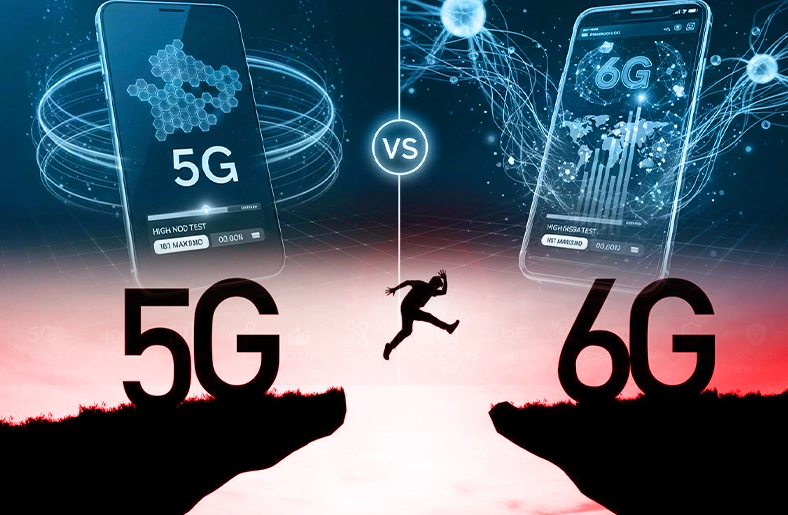
20-Second Summary
The wireless technology has always been evolving rapidly, and today we are already preparing ourselves for the arrival of 6G technology.
As the world is already converting to 5G, by changing their devices, we are standing at a crossroad in the history of the mobile industry, which is expecting to have 6G effective from 2030.
- If you’re wondering about the differences between 5G and 6G, you’re not alone.
- 5G vs 6G represents a generational jump in terms of speed, latency, and capability that will change the way we interact with technology.
The evolution from 4G LTE to 5G took almost a decade, but now that the 5G deployment has reached the masses, the tech industry is already preparing for the arrival of 6G by 2030. This means there is a technology shift coming with 6G mobile networks, where 6G will eventually succeed 5G.
This blog will explore how these technologies differ from each other and how they will impact our lives.
Understanding the Fundamentals: 5G and 6G Explained
Before diving deep into the blog, let us first understand both technologies in a nutshell.
What is 5G Technology?
5G mobile technology was launched in 2019 and is the fifth generation of cellular networks.
The technology operates at frequencies up to 100 GHz and provides speeds of 20 Gps in ideal conditions, but most people experience speeds between 70 and 300 megabits per second, depending on how busy the network is and where they are.
The key innovation of 5G is its multi-layered approach using three frequency bands
- Low-band (Sub-1 GHz): Wide coverage, slower speeds
- Mid-band (1-6 GHz): Balanced coverage and speed
- High-band or millimeter-wave (24-100 GHz): Extreme speed, limited range
What is 6G Technology?
6G mobile networks are not yet established and are still in their early developmental stages, with the predictions of their arrival in 2030. While the 5G operates up to 100 GHz, 6G technology will be leveraging terahertz frequencies up to 3000 GHz (3 THz).
6G standards are being developed under the ITU’s IMT-2030 framework, bringing together global experts to shape the next generation of wireless technology.
Speed Comparison: The Most Dramatic Difference
The comparison table given below sheds light on how 5G and 6G differ in speed, performance, and early test results. This will help you to understand the big leap 6G is expected to bring.
| Feature | 5G | 6G |
| Theoretical maximum speed | 20 Gbps | 1 Tbps projected |
| Real-world average speed | 70 to 300 Mbps | Not yet commercial; early tests show multi-Gbps |
| Peak performance | 1 to 2 Gbps on mmWave | Expected to reach hundreds of Gbps to 1 Tbps |
| Verified test results | Commercial networks reach up to 1–2 Gbps | Samsung reached 6 Gbps at 15 meters. LG achieved stable transmission at 500 meters. A Chinese team recorded 206.25 Gbps. Osaka and Adelaide researchers built a chip reaching 11 Gbps. |
| Key limitations | Congestion, distance, obstacles, device hardware | Early work depends on the terahertz spectrum and advanced antennas |
| Typical use cases | 4K and 8K streaming, cloud gaming, fast downloads | Real-time holograms, instant data transfers, and advanced AI applications |
| Time to download 25 GB | 10 minutes | 0.2 seconds |
Latency and Response Time
Latency measures the delay between sending a signal and receiving a response, which is measured in milliseconds (ms) or microseconds (μs).
5G Latency Performance
5G latency ranges from 1 to 5 milliseconds when conditions are ideal, which is a huge improvement when compared to 4G’s 50ms average
- 1 millisecond theoretical minimum
- 5 to 10 milliseconds real-world average
- <1 ms URLLC (Ultra-Reliable Low-Latency) for specialized applications
- Enhancement for use cases: Remote surgery, autonomous vehicles, industrial automation
This ultra-low latency makes breakthroughs possible, including remote surgery with haptic feedback, real-time communication between autonomous vehicles, precise robot control in smart factories, and cloud gaming with almost no input lag.
6G Latency: The Microsecond Era
6G latency targets below 1 microsecond (0.001 milliseconds) for ultra-critical applications, with broader target of 100 microseconds (0.1 milliseconds) end-to-end latency. This fundamental shift will enable entirely new categories of applications.
6G ultra-low latency advantages:
- A 1-microsecond response time will allow real-time holographic communication
- Haptic Internet will provide touch-enabled experiences over wireless networks
- Network processes decisions faster than human perception using AI-driven decisions.
- Real-time mirroring of physical systems with zero perceptible lag
Frequency Spectrum Analysis: From Millimeter-Wave to Terahertz
5G uses millimeter wave signals, while 6G moves into the terahertz range, which gives it far more power and capacity.

The challenge with millimeter wave is that it is expensive to deploy and has not had a strong must-have use case, so many regions have been slow to roll it out widely.
5G Spectrum: Understanding Millimeter-Wave Technology
- 5G works across three main frequency bands.
Sub 1 gigahertz covers long distances but offers slower speeds and is used mostly in rural areas.
The mid band between 1 and 6 gigahertz provides the best mix of speed and coverage.
The millimeter wave band from 24 to 100 gigahertz delivers very fast speeds but only works over short distances of about a thousand feet.
6G Terahertz Spectrum: The Revolutionary Leap
6G takes a major step forward by using terahertz frequencies from 95 to 3000 gigahertz.
These signals can support
- Huge amounts of data
- Serve billions of devices at once
- Sense the environment while transmitting data
- Detect very small objects
- And use AI to focus the signal more precisely.
5G mmWave vs 6G THz spectrum comparison
The table below compares 5G millimeter-wave and 6G terahertz spectra, highlighting key differences in frequency, speed, range, device capacity, and sensing capabilities.
| Aspect | 5G mmWave | 6G Terahertz |
| Frequency Range | 24-100 GHz | 95 GHz – 3 THz |
| Data Rate | 20 Gbps theoretical | 1 Tbps projected |
| Range | ~1,000 feet | ~500 feet (improving) |
| Capacity | 1 million devices/km² | 10+ million devices/km² |
| Sensing Capability | Limited | Native/integrated |
6G overcomes the challenges of higher-frequency signals through advanced technology.
Network Capacity and Device Support
With the help of network capacity comparison, we can see why we still need 6G, despite having 5G providing great benefits.
| Aspect | 5G | 6G |
| Device density | 1 million devices/km² | 10+ million devices/km² |
| Network architecture | Network slicing for different use cases | AI-native, self-healing, and self-optimizing |
| Spectral/energy efficiency | ~15 bps/Hz | Higher efficiency, better performance with lower power |
| Real-world limitations | Crowds at stadiums or events can exceed capacity | Designed to handle billions of connections at the same time |
| Device support | iPhone 15/16, Samsung Galaxy S24, Google Pixel 9 | Future devices under development, designed for full 6G compatibility |
| Adoption/coverage | ~65% of smartphones support 5G; 35-40% US population coverage | Expected global adoption; widespread high-capacity coverage |
| Network intelligence | Mostly cloud-managed | Distributed intelligence with edge decision-making |
| Key advantage | Reliable for current mobile needs | Massive IoT support, ultra-high device density, AI-driven efficiency |
Smartphone 6G Compatibility: Timeline and Requirements
While 5G devices are already functioning globally, Smartphone 6G compatibility won’t arrive until 2028-2030 at the earliest, and the major reason behind that is the requirement of new technological developments that need time.
Required technological developments for 6 G-enabled mobiles include the following:
- New chipsets: Qualcomm, Apple, and Samsung must design with processors that are capable of 6G technology.
- Advanced antennas: Metamaterial and metasurface antenna arrays
- Specialized modems: Distinct from 5G modems with THz support
- Enhanced power management with innovative battery tech is required for THz communication
- Thermal management will be needed because Millimeter-scale components generate significant heat
As of 2024, no 6G smartphones exist, with commercial availability expected in the early 2030s following standardization milestones.
Real-World Applications of 5G
- 5G is providing many benefits to the healthcare sector that include enabling remote surgery, telemedicine, real-time health management, and the transmission of high-resolution medical images, while improving patient care with fast, reliable internet.
- 5G also has important use cases in the entertainment and media sector, where it is supporting 4K and 8K streaming, cloud gaming, live 360° sports coverage, and virtual concerts with minimal latency for immersive experiences.
- In industrial IoT and manufacturing, 5G powers smart factories, autonomous vehicle communication, smart city infrastructure, and beyond-line-of-sight drone operations, driving efficiency and automation.

Future 6G Use Cases and Revolutionary Applications
Below are some interesting use cases of 6G, including some revolutionary applications in different industries that we can expect.

Holographic Communication and 3D Telepresence
This will enable people to appear as their own life-size holograms to interact with others from a distance, and might enable remote medical procedures.
Extended Reality (AR, VR, Mixed Reality)
6G will power immersive virtual worlds with seamless experiences, enabling:
- Holographic gaming
- Virtual try-ons for shopping
- Interactive learning environments
- Attending events as if you were there in person
Healthcare Breakthroughs
6G will allow remote surgeries, instant AI-powered diagnostics, real-time monitoring through nano-sensors, personalized treatments based on genetic data, and AI-guided emergency response.
Industrial and Enterprise Applications
6G will let factories have real-time 3D digital models, allow robots and vehicles to work together, make instant decisions on-site, and run industrial operations efficiently without errors.
Massive IoT and Smart Earth
- 6G will connect billions of devices worldwide
- Provide global satellite coverage
- Monitor the environment in real time
- Optimize agriculture with precision farming
- Create smart homes that adapt to residents’ needs
6G Rollout Timeline and Deployment Strategy
The industry plans to roll out 6G by 2030.
- The study of 6G requirements at the 3GPP level runs from September 2024 to June 2026
- Technical work starts in the third quarter of 2025
- The full 6G specifications are expected by the end of 2028.
Detailed 6G Rollout Timeline
- 2024-2025 Standards finalization and prototype development
- 2025-2026 3GPP Release 20 work on 5G-Advanced and early 6G requirements
- From 2026 to 2028, detailed design and implementation specifications will be made
- In 2028, the first 6G standards will be completed
- From 2029 to 2030, there will be an initial commercial deployment in major urban centers
- From 2030-2035the global rollout phase across developed nations will begin
- 2035+ Full maturity and ubiquitous coverage
Regional 6G Deployment Variations
Different regions will adopt 6G at different timelines. A detailed expected deployment variation based on different regions has been given below.
| Region | Key Highlights | Initial Deployment | Full/Nationwide Rollout |
| North America | U.S. views 6G as vital for global tech and economic leadership; NSF and DOE funding foundational research | Major cities: 2029-2030 | Nationwide: 2035+ |
| Europe | Hexa-X II initiative drives development; Germany will open a 6G Hub that will act as a regulatory sandbox | 2029-2031 | 2033-2036 |
| Asia-Pacific | China prioritizes 6G nationally; South Korea & Japan heavily invest; Samsung expects early commercialization | Earliest: 2028 | Deployment surge: 2030-2032 |
| Other Regions | India’s Bharat 6G Alliance coordinates development; MENA focuses on AI networks; Africa emphasizes satellite-based coverage | Varies by country; India: 2027-2028 (government targets 2025 but realistic deployment later) | Varies by country |
Note: India’s 6G timeline represents government targets; actual deployment is likely happening between 2027-2028 based on typical research-to-deployment cycles.
Comprehensive Technology Breakdown between 5G and 6G
Based on the information provided above, let us now leave you with a quick comparison table for all the key detail information given above, so that you can look at the comparison once again as a quick context.

| Technical Specification | 5G | 6G |
| Speed | 20 Gbps theoretical / 70-300 Mbps real-world | 1 Tbps theoretical / 100+ Gbps projected real-world |
| Latency | 1-5 milliseconds (URLLC: <1 ms) | <1 microsecond |
| Frequency | 5-100 GHz (mmWave) | 95 GHz – 3 THz |
| Device Capacity | 1 million/km² | 10+ million/km² |
| Range | 1000+ feet mmWave / 5+ miles sub-6 | ~500 feet (improving with research) |
| Deployment Start | 2019 (commercial) | ~2030 (projected) |
| Coverage Today | 35-40% (US) | Not deployed |
| AI Integration | Basic machine learning | Native AI/ML core architecture |
| Sensing Capability | Passive communication only | Active environmental sensing |
| Energy Efficiency | Good | Excellent (target) |
| Device Availability | Mass market (all flagship phones) | Expected 2028+ |
| Cost per GB | $5-15/GB | Projected $0.50-2/GB |
6G vs 5G Pros and Cons
Now that we have seen both technologies in comparison in detail, let us have a look at their pros and cons individually.
5G Advantages
- Already available and deployed widely
- Devices accessible at all price points
- Proven reliability in real-world conditions
- Immediate business applications available
5G Disadvantages
- Coverage gaps in rural/underserved areas
- Limited device density in high-congestion zones
- Cannot support emerging applications (holographics, haptics)
- Spectrum costs limit profitability for carriers
6G Advantages
- 50-1000x speed improvement enabling new applications
- Microsecond latency enabling haptic communication
- 10x device density improvement for IoT
- AI-native architecture for intelligent networks
- Sensing capability beyond communication
6G Disadvantages
- Not available commercially until 2030+
- Devices not expected until 2028-2031
- Massive infrastructure investment required
- Signal range shorter than 5G in initial deployments
- Standards still being finalized
Final Remarks
This comparison between 5G vs 6G in mobiles is showcasing two different technological eras, where 5G is in action already, and 6G is expected to reveal its use case in the real world, enabling the applications that are currently just science fiction.
Even though 6G is expected to bring newer changes and advanced applications, we suggest that everyone adapt to 5G before its arrival, to understand the new technology while monitoring 6G development for future planning.
By 2030, future mobile connectivity will begin shifting toward 6G. By 2035, 6G networks will dominate developed nations, enabling applications we can barely imagine today, and we are as excited as you are to experience this technological shift.
To stay updated on all the upcoming 5G and 6G technological information, stay connected with Ai Technology Tips.
Frequently Asked Questions
Can my 5G phone work on 6G networks?
6G technology might be less likely to be compatible with 5G devices, hence you might need to buy new devices supporting 6G technology.
When will 6G be available in my city?
Major metropolitan areas will see initial 6G deployment around 2030-2031. Full city coverage won’t arrive until 2033-2035.
Is 5G still worth buying in 2025?
Yes. 5G will remain the primary technology through 2030+ and offers genuine value.
What companies are leading 6G development?
Ericsson, Nokia, Samsung, Huawei, Apple, and telecommunications operators like SK Telecom and NTT Docomo are leading companies invested in the 6G development.
Will 6G require completely new infrastructure?
Some partial changes will be required in the infrastructure for 6G deployement. Existing fiber backhaul can be upgraded, but 5-10x more base stations will be needed for THz coverage.

